
SAP systems and their (unknown) interfaces
 Interfaces are critical for business processes because they ensure the exchange of information within the system landscape and to external communication partners. Undocumented or obsolete interfaces sometimes pose significant security risks. Obsolete and incompatible interfaces can lead to sensitive disruptions in business operations. In the context of "indirect SAP use", it is also important to know in what form and to what extent an interface is subject to additional licensing by SAP. Finding this out is relatively complicated due to the unclear legal assessment of current SAP licensing practice as well as the continuous adaptation of SAP licensing policy.
The importance for companies to know and understand their interfaces was demonstrated by the ruling in SAP UK Limited v. Diageo Great Britain Limited. SAP had sued for back-payment of license and maintenance fees of over GBP 54 million (over EUR 62 million), referring to users who access Diageo's SAP system via interfaces using other applications. The court agreed with SAP's view that indirect access also gives rise to a right to user fees. This shows: SAP customers need to be aware of all the variables that can cause costs in terms of the SAP license agreement when integrating third-party products into their SAP landscape.



Recognize and act quickly
To determine the potential for liability and possible additional fees under an SAP license agreement, the interface environment in a customer's SAP installation must be quickly and accurately determined. Interfaces are the "gateways" for data flow in and out of the SAP system. At the same time, they are the mechanisms that can justify charges to indirect users under SAP license agreements. Unfortunately, many companies lack accurate information about their interface landscape - a significant risk in terms of licensing, security and compliance.
Customers should analyze their systems thoroughly to get an accurate picture of all existing interfaces. There are different methods for this. The most common is a manual review combined with a system check. But a manual process is not recommended because it is a labor-intensive, time-consuming and overall inefficient procedure that is highly prone to errors.
Common problems in identifying interface environments include:
- Lack of knowledge about the type and number of interfaces.
- Missing, incomplete or outdated interface documentation.
- No central access to interface information.
- No suitable graphical representation of the interface topology.
- Irrelevant data sets and lack of filtering options, making manual analysis and evaluation cumbersome, costly and frustrating.
Accuracy and speed are crucial, however, and so SAP customers should only use proven and, above all, automated solutions. The SNP Interface Scanner, for example, produces exact results:
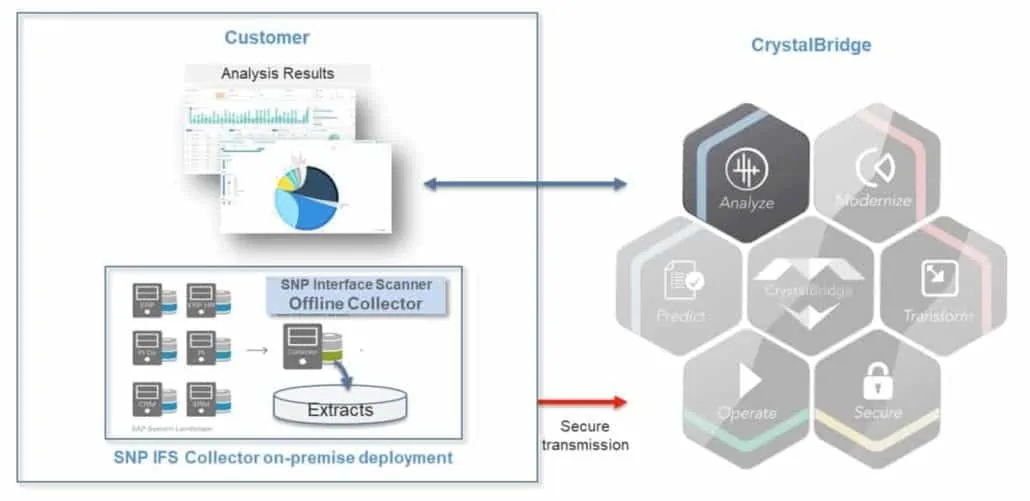
Interface analyses are extremely important in order to evaluate the risk of additional license and maintenance fees to be paid to SAP in an overall view and to be able to prepare optimally for the annual SAP license audit. Therefore, trust the experience and knowledge of a reliable partner.
 DE
DE EN
EN ES
ES